Spillovers in Spatial Interaction Models
Spatial interaction models are a classic but powerful tool in the kit of spatial analysis. Used widely in transportation modeling, migration research, and trade flows, among others, spatial interaction models are designed to model the movement of [ideas, capital, commodities, people, etc.] between two locations.
In the figure below, for example, we focus on commute flows originating from a single census tract in Washington D.C., and visualize the number of travelers moving to all other tracts in the city during the A.M. commute.
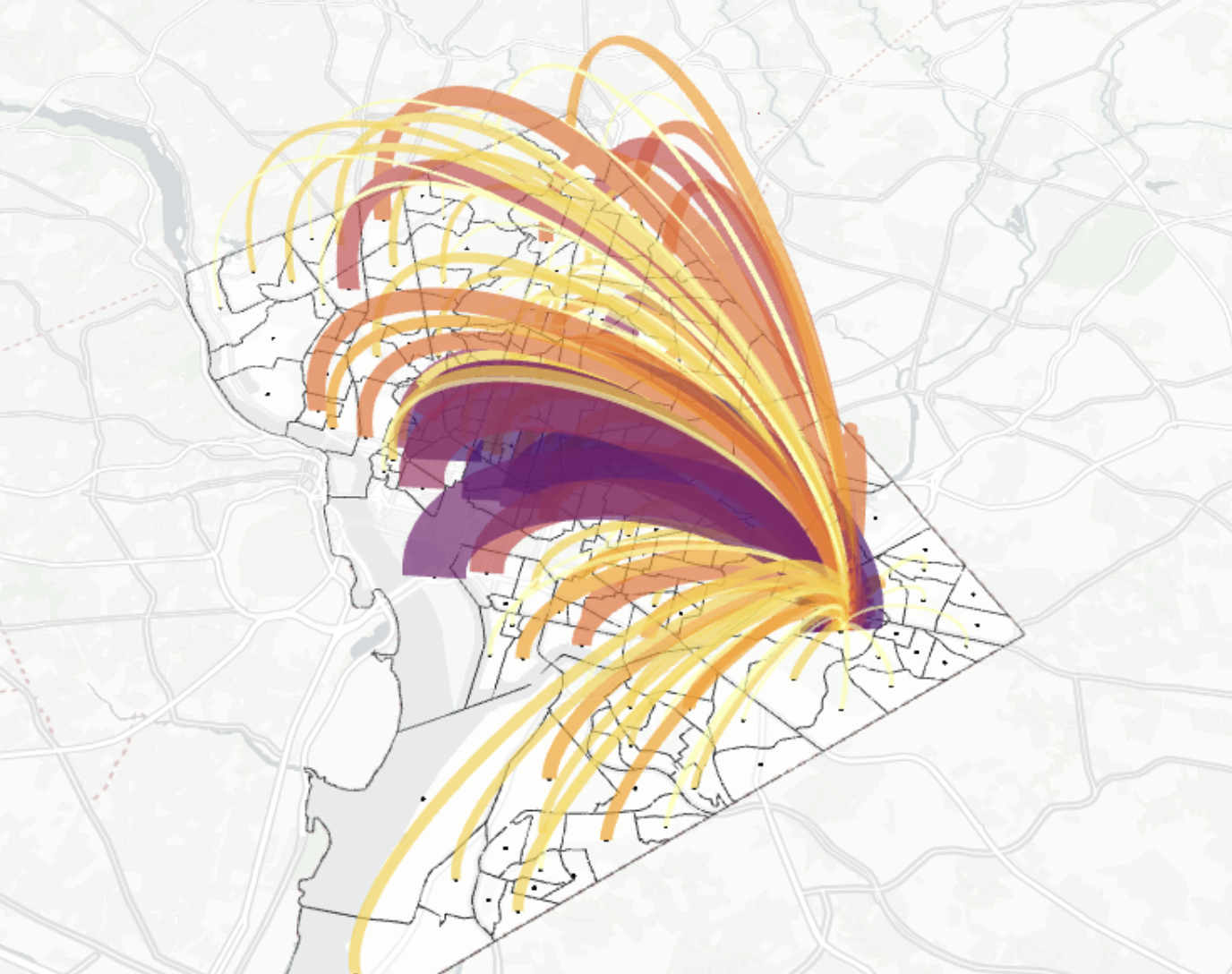
The task in spatial interaction modeling is to predict these flows using characteristics of the origin, the destination(s), and the distance that separates the two–and to do so for all pairs of units in the study region.
Last summer I taught a workshop for the Northeastern Regional Science Association on spatial interaction models with classic and spatial econometric approaches using the PySAL stack.